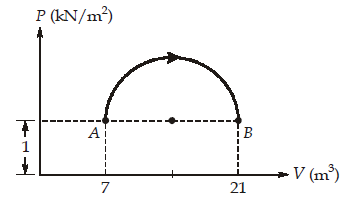
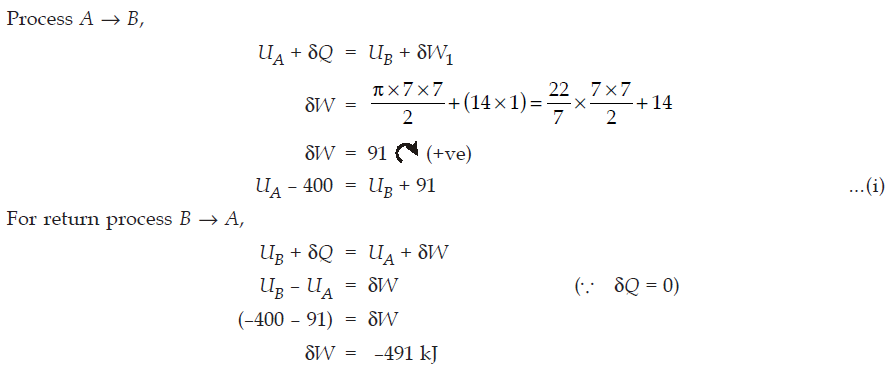
Q1. Consider a control mass which undergoes a process from state ‘A’ to state ‘B’ as shown in figure. During the process heat rejected is 400 kJ. If the same control mass returned adiabatically from state ‘B’ to state ‘A’ by another process, then work interaction during return process will be
(a) 491 kJ
(b) 309 kJ
(c) –309 kJ
(d) –491 kJ
Ans. d
Sol.
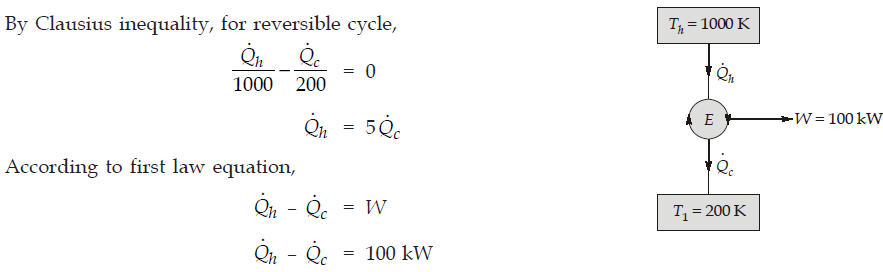
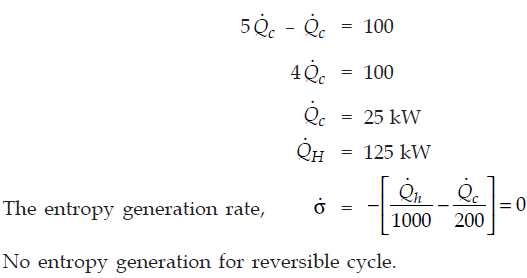
Q2. The rate of entropy generation when the engine is completely reversible, will be
(a) 0 kW/K
(b) 0.2 kW/K
(c) –0.2 kW/K
(d) 0.5 kW/K
Ans. a
Sol.
Q3. An ideal gas flowing through insulated pipe, undergoes throttling process, then the temperature of the gas will
(a) increase
(b) decrease
(c) remains constant
(d) increase or decrease
Ans. c
Sol.
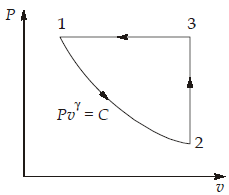
Q4. Which of the following is CORRECT T-s diagram for the cycle shown below on P-v diagram?
(a) 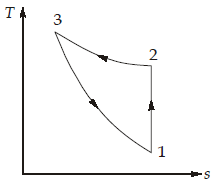
(b) 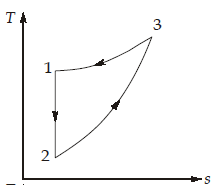
(c) 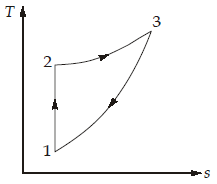
(d) 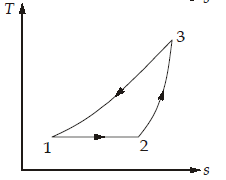
Ans. b
Sol.
Q5. The degradation of energy is due to
(a) Entropy generation within the system
(b) Decrease of entropy within the system
(c) Maximum work done by the system
(d) None of the above
Ans. a
Sol.
Q6. There are two identical bodies, whose initial temperatures are 200 K and 3200 K. If specific heat C = 2.5 kJ/K, for both bodies, the maximum amount of work that can be extracted in the process, when the two bodies are brought at same temperature, is
(a) 6000 kJ/kg
(b) 1500 kJ/kg
(c) 4500 kJ/kg
(d) 800 kJ/kg
Ans. c
Sol.
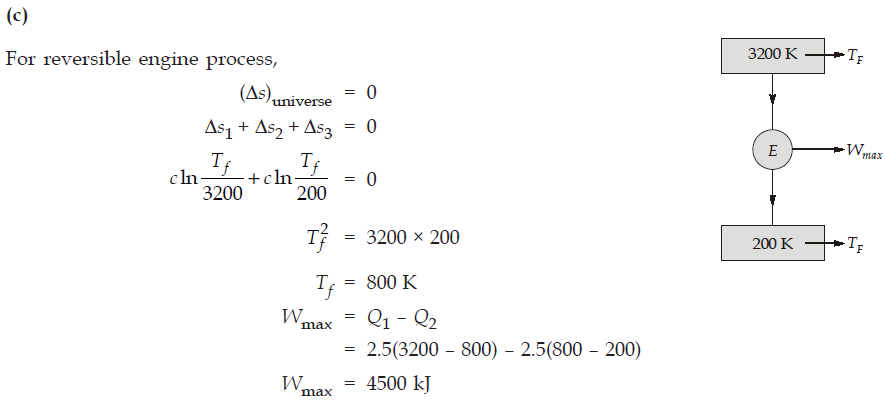
Q7. COP for thermo-electric refrigeration system
(a) Reduces very fast with increasing refrigeration temperature.
(b) Reduces very fast with decreasing refrigeration temperature.
(c) Does not depends on the refrigeration temperature.
(d) Increases very fast with decreasing refrigeration temperature.
Ans. b
Sol.
As the temperature of cold side of the thermo-electric device decreases the electric resistance of the thermo-electric materials (typically semiconductors) increases. This leads to higher power consumption for the same amount of refrigeration which reduces the COP.
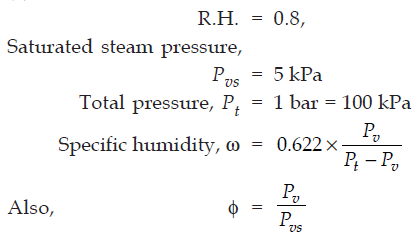
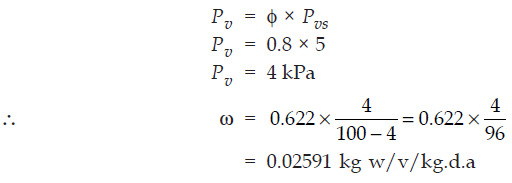
Q8. The pressure, dry bulb temperature (DBT) and relative humidity (RH) of air in a room are 1 bar, 30°C and 80% respectively. If the saturated steam pressure at 30°C is 5 kPa, the specific humidity of the room air is [Take 1 bar = 100 kPa]
(a) 0.0083 kg/kg.d.a.
(b) 0.0191 kg/kg.d.a.
(c) 0.02591 kg/kg.d.a.
(d) 0.2421 kg/kg.d.a.
Ans. c
Sol.
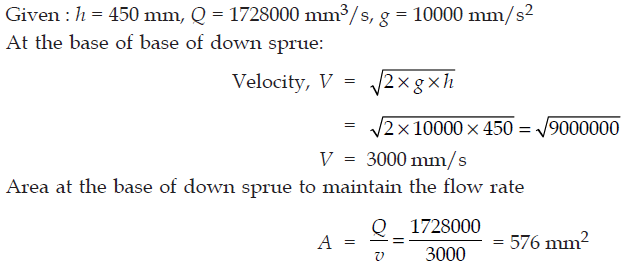
Q9. In a sand mould, a sprue of 450 mm height and 1152 mm2 top area is provided to maintain the flow rate of liquid at 1728000 mm3/s. What should be the area, at the base of down sprue to prevent aspiration of molten metal?
[Take g = 10000 mm/s2]
(a) 676 mm2
(b) 476 mm2
(c) 776 mm2
(d) 576 mm2
Ans. d
Sol.
Q10. Match List-I (Smithy tools) with List-II (Uses) and select the correct answer using the codes given below the lists:
List-I
A. Hot set
B. Gouge
C. Anvil
D.Fullers
List-II
1. To forge art, bend and shape the work
2. To cut hot metal
3. To shape inside curves, to form corrugations for elongating metal
4. To cut plates to curves
Codes:
A B C D
(a) 2 4 1 3
(b) 2 4 3 1
(c) 2 1 4 3
(d) 3 2 1 4
(a) (a)
(b) (b)
(c) (c)
(d) (d)
Ans. a
Sol.
Hot set = To cut hot metal
Fullers, top and bottom = To shape inside curves. To form corrugations for elongating metal
Swages, top and bottom = To shape convex surfaces and to give finish to round,
square, hexagonal or octagonal shaped sections
Anvil = To forge art, bend and shape the work
Sewage block = To shape or bend the work to any form and to knock
heads of bolts, etc.
Gouge = To cut plates to curves
Q11. The casting defect ‘Flashes of fins’ are caused by
1. Loose clamping of the mould.
2. Excessive weight on the top part of the mould.
3. Insufficient rapping of the pattern.
Which of the above reasons are INCORRECT?
(a) 1 and 2 only
(b) 2 and 3 only
(c) 1 and 3 only
(d) 1, 2 and 3
Ans. b
Sol.
Flashes of fins are thin projections of metal not intended as a part of casting. These usually occur at the parting line of the mould or core section. These are caused by loose clamping of the mould, insufficient weight on the top part of the mould and excessive rapping of the pattern before it is withdrawn from the mould.
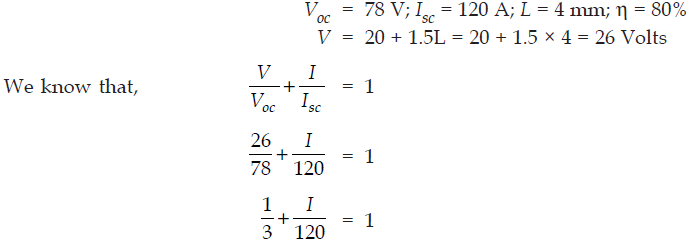
Q12. It is required to weld a low carbon steel plate by the manual metal arc welding process using a linear V.I. characteristics D.C. power source. The following data are available:
Open circuit voltage of power source = 78 V; Short circuit current = 120 A;
Arc length = 4 mm;
Transverse speed of welding = 15 cm/min; Efficiency of heat input = 80%;
Voltage is given as, V = 20 + 1.5L
[L being arc length in mm]
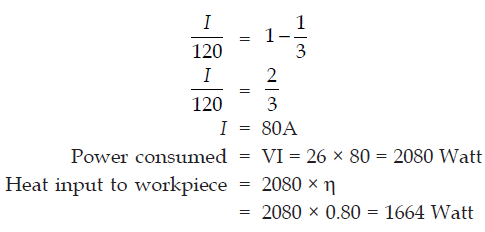
What will be the required heat input to the workpiece?
(a) 1648.9 W
(b) 1664 W
(c) 2648.9 W
(d) 2664 W
Ans. b
Sol.
Q13. Consider the following statements regarding grinding wheels used in machining:
1. The grain size of the abrasive in a grinding wheel determines the material removal rate and surface finish.
2. The structure of a grinding wheel refers to the spacing between abrasive grains, affecting chip clearance and cooling.
3. Vitrified bond grinding wheels are more flexible compared to resin bond grinding wheels.
Which of the above statements are CORRECT?
(a) 1 and 2 only
(b) 2 and 3 only
(c) 1 and 3 only
(d) 1, 2 and 3
Ans. a
Sol.
• The grain size determines the material removal rate and surface finish. Coarse grains remove material faster but produce a rougher finish, while fine grains provide a smoother finish.
• The structure of a grinding wheel refers to the spacing between abrasive grains, which influences chip clearance, heat dissipation and overall grinding performance.
• Vitrified bond grinding wheels are rigid and brittle, offering high precision but little flexibility. Resin bond grinding wheels are more flexible and impact-resistant, making them suitable for high speed grinding and heavy material removal.
Q14. Which type of fit is best suited for applications where parts must be assembled with pressure and force, ensuring no relative motion between them?
(a) Clearance fit
(b) Transition fit
(c) Interference fit
(d) Loose running fit
Ans. c
Sol.
Q15. 
(a) 10 μm
(b) 20 μm
(c) 30 μm
(d) 40 μm
Ans. c
Sol.
After electro-plating,
Minimum hole diameter = 50.020 – 0.030 × 2
= 49.960 mm
Maximum shaft diameter = 50.000 – 0.010
= 49.990 mm
Maximum interference = 49.990 – 49.960
= 0.030 mm or 30 μm
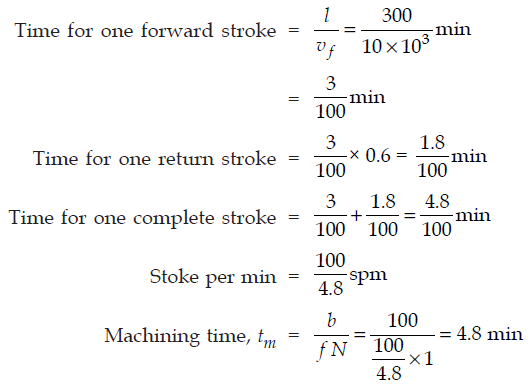
Q16. A shaper machine is used to machine a mild steel block of 300 mm length and 100 mm width. The tool move at 10 m/min during the forward stroke, and the return stroke takes 40% less time than the forward stroke. The feed per stroke is 1 mm. The total machining time is
(a) 4.2 min
(b) 4.8 min
(c) 4.5 min
(d) 3.4 min
Ans. b
Sol.
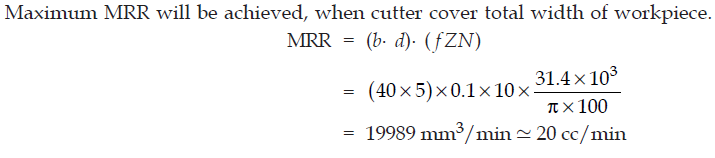
Q17. In a face milling operation the following observation are made while facing MS block using a HSS
cutter:
Cutting speed, v = 31.4 m/min
Feed, f = 0.1 mm/tooth
Width of cut, b = 40 mm
Depth of cut, d = 5 mm
Cutter diameter, D = 100 mm
Number of teeth, Z = 10
The maximum material removal rate is closest to
(a) 40 cc/min
(b) 20 cc/min
(c) 60 cc/min
(d) 80 cc/min
Ans. b
Sol.
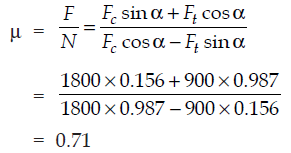
Q18. During the orthogonal cutting of a component, the feed and cutting forces involve are 900 N and 1800 N respectively. If the rake angle of tool used is 9°, then the coefficient of friction at chip tool interface is
(Take sin9° = 0.156 and cos9° = 0.987)
(a) 0.71
(b) 1.25
(c) 0.24
(d) 0.95
Ans. a
Sol.
Q19. Consider the following statements about the relationship between lattice parameter and atomic radius for a BCC structure
1. Atoms touch along the body diagonal.
2. Atoms at corner touch along the edge.
Which of the above statements is/are INCORRECT?
(a) 1 only
(b) 2 only
(c) Both 1 and 2
(d) Neither 1 nor 2
Ans. b
Sol.
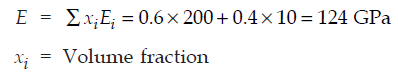
Q20. A unidirectionally aligned carbon fibre reinforced epoxy composite is loaded as shown in the figure. The volume fraction of the fibre is 0.6.
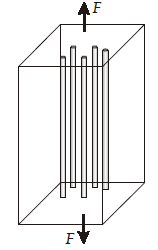
If the Young’s modulus of the fibre and the matrix are 200 GPa and 10 GPa respectively, then the Young’s modulus of the composite is
(a) 86 GPa
(b) 124 GPa
(c) 105 GPa
(d) 38 GPa
Ans. b
Sol.
Q21. Which of the following is the most favourable slip system to produce slip in FCC materials?
(a) {1 1 0}(1 1 1)
(b) {1 1 1}(1 1 0)
(c) {1 0 0}(0 1 0)
(d) {2 1 1}(1 1 1)
Ans. b
Sol.
In FCC, slip occurs on the {1 1 1} planes, which have the highest atomic packing density, and along the (1 1 0) direction, which is the most closely packed direction in that plane.
Q22. The normal stress is the same in all directions at a point in a fluid
(a) Only when the fluid is frictionless
(b) Only when the fluid is frictionless and incompressible
(c) Only when the fluid is incompressible
(d) When the fluid is at rest, regardless of its nature
Ans. d
Sol.
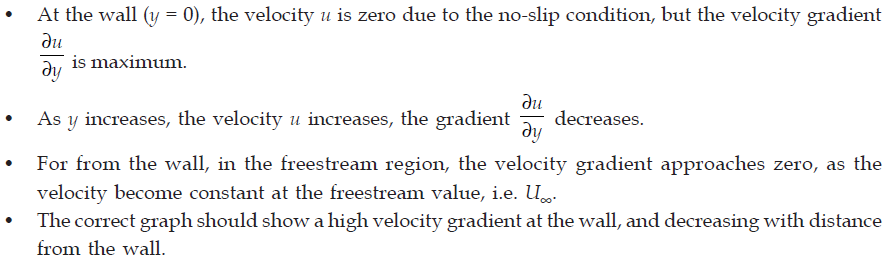
Q23. 
(a) 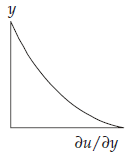
(b) 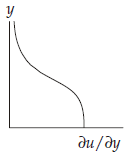
(c) 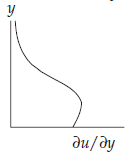
(d) 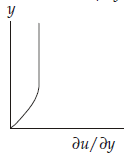
Ans. b
Sol.
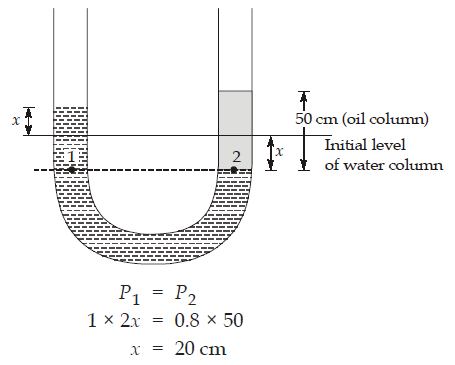
Q24. An open U-tube manometer contains water, an oil of specific gravity 0.8 is poured into one of its limbs so that length of column of oil is 50 cm. The level of water column in that limb is lowered approximately by
(a) 10 cm
(b) 20 cm
(c) 30 cm
(d) 40 cm
Ans. b
Sol.
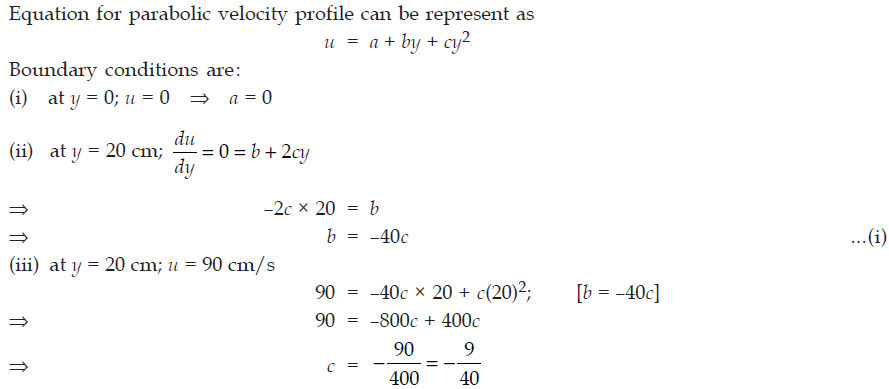
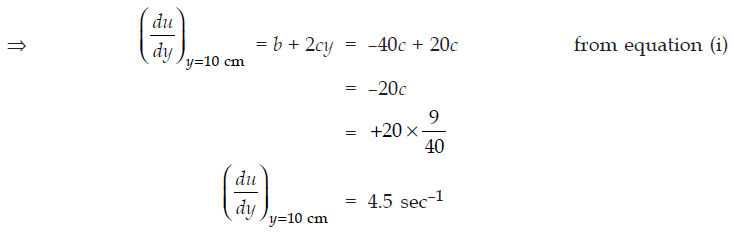
Q25. If velocity profile of a fluid over a flat plate is parabolic and the free stream velocity of 90 cm/s occurs at a distance of 20 cm from plate then velocity gradient at a distance of 10 cm from plate is
(a) 9 sec–1
(b) 4.5 sec–1
(c) 2.25 sec–1
(d) 3.25 sec–1
Ans. b
Sol.
Q26. 
(a) 
(b) 
(c) 
(d) 
Ans. a
Sol.
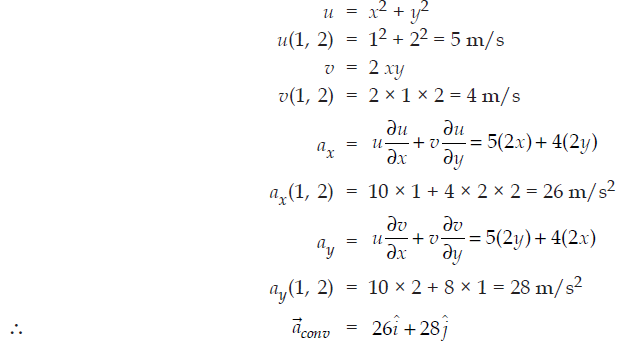
Q27. Which one of the following statement is INCORRECT regarding pipe flow?
(a) The total head loss in the pipe consists of major losses due to friction and minor losses due to fittings, bends, expansion and contractions.
(b) The Darcy-Weisbach equation for head loss due to friction is only applicable for horizontal pipe.
(c) 
(d) 
Ans. b
Sol.
The Darcy-Weisbach equation is not limited to horizontal pipes. It is applies to any fully developed, steady, incompressible flow in a closed conduit, regardless of pipe orientation.
Q28. A pipe of diameter D conveying a discharge Q is to be replaced by two parallel pipes of smaller diameter d. If friction factor is same for all pipes, then the ratio D/d for same length is
(a) 2
(b) 41/5
(c) 41/3
(d) 
Ans. b
Sol.

Q29. Three reservoirs A, B and C are interconnected by pipes as shown in figure. Water surface elevations in the reservoirs and the Piezo-metric head at the junction ‘J ’ are indicated in the figure.
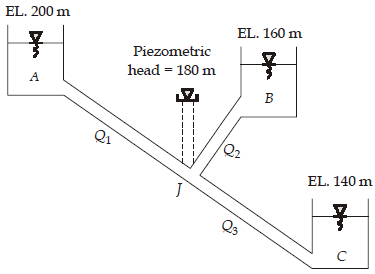
Discharge Q1, Q2 and Q3 are related as
(a) Q1 + Q2 = Q3
(b) Q1 + Q2 + Q3 = 0
(c) Q1 + Q2 = Q3
(d) Q2 + Q3 = Q1
Ans. d
Sol.
Flow always takes place from high energy to low energy.
Q1 = Q2 + Q3
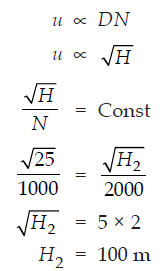
Q30. A centrifugal pump runs at 1000 rpm and generates a head of 25 m. If the pump speed is doubled while maintaining the same efficiency, what will be the new head developed by the pump?
(a) 25 m
(b) 50 m
(c) 75 m
(d) 100 m
Ans. d
Sol.
Q31. Match List-I with List-II and select the correct answer using the codes given below the lists:
List-I
A. Rotational flow
B. Vortex flow
C. Free vortex
D.Forced vortex
List-II
1. A fluid motion in which streamlines are concentric circles.
2. The fluid particle moving in concentric circles may not rotate about their mass centres.
3. The fluid particle moving in concentric circles may rotate about their mass centres.
4. Flow near a curved boundary.
Codes:
A B C D
(a) 4 2 3 1
(b) 3 1 2 4
(c) 3 2 1 4
(d) 4 1 2 3
(a) (a)
(b) (b)
(c) (c)
(d) (d)
Ans. b
Sol.
Q32. In a balanced counterflow heat exchanger, the product of specific heat and mass flow rate is same for hot and cold fluids. If NTU is equal to 5, then the effectiveness of the heat exchanger is
(a) 50.18%
(b) 67.67%
(c) 83.33%
(d) 92.83%
Ans. c
Sol.

Q33. A hot plate at an initial temperature of 180°C is kept vertically in still air at 30°C and
cools down to 80°C due to convection only. The plate has mass of 20 kg, and its specific heat capacity is 400 J/kgK. If the convective heat transfer coefficient is 5 W/m2K, and the plate surface area is 1 m2, what is the time required for the plate to reach 80°C temperature?
(a) 1757.77 sec
(b) 878.89 sec
(c) 439.44 sec
(d) 672.57 sec
Ans. b
Sol.
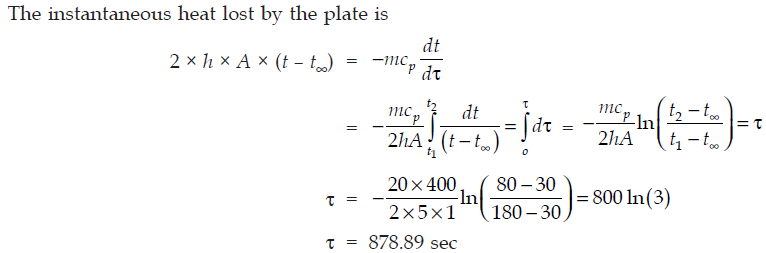
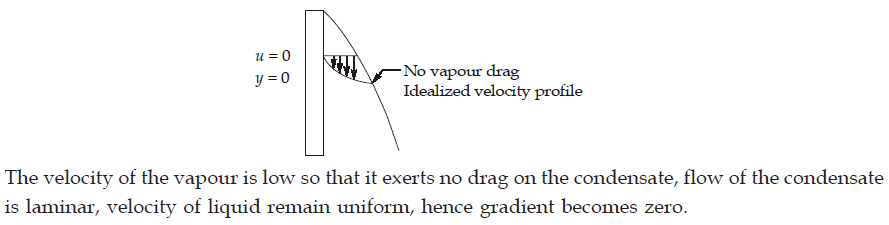
Q34. At the liquid – vapour interface in laminar film condensation on a vertical plate
(a) The velocity gradient is maximum at interface
(b) The velocity gradient at the interface is zero.
(c) The velocity gradient follows a parabolic profile.
(d) There is no velocity at the interface.
Ans. b
Sol.
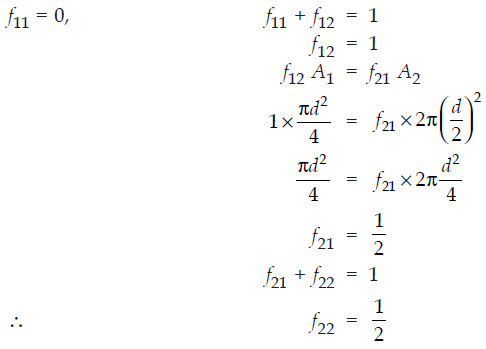
Q35. The view factor f22 for hemisphere as shown in the figure is
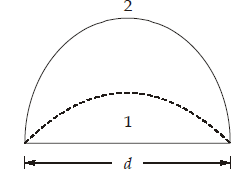
(a) 1/2
(b) 1/4
(c) 1
(d) 0
Ans. a
Sol.
Q36. Which is the primary reason for high HC emission during engine startup?
(a) Lean air-fuel mixture
(b) Complete combustion
(c) Rich air-fuel mixture
(d) High compression ratio
Ans. c
Sol.
High HC emissions during engine startup occur due to incomplete combustion caused by a rich air-fuel mixture, cold cylinder walls, poor fuel atomization, and weak ignition. Additionally, the catalytic converter is inactive at low temperatures, failing to reduce emissions effectively. As the engine warms up, HC emissions decrease
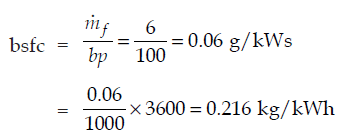
Q37. A diesel engine has a fuel consumption of 6 grams per second, when the power output is 100 kW. The brake specific fuel consumption is
(a) 0.216 kg/kWh
(b) 0.714 kg/kWh
(c) 0.06 kg/kWh
(d) 0.842 kg/kWh
Ans. a
Sol.
Q38. Consider the following statements:
1. A hollow shaft can carry more power for the same weight compared to a solid shaft.
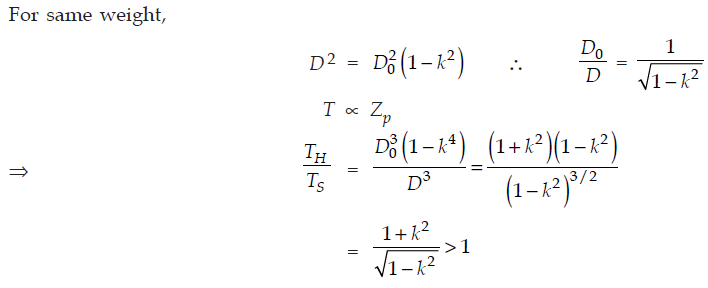
2. Torsional rigidity is used to design a shaft based on rigidity criteria.
3. For two shafts, having parallel connection, the angle of twist will be same.
Which of the above statements are CORRECT?
(a) 1 and 2 only
(b) 2 and 3 only
(c) 1 and 3 only
(d) 1, 2 and 3
Ans. d
Sol.
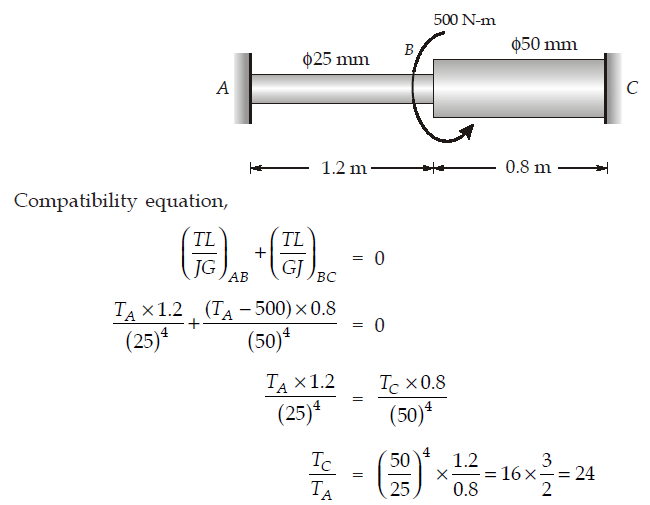
Q39. A stepped shaft fixed at both end, consists of two segments in series. The first segment has a diameter of 25 mm and a length of 1.2 m, while the second segment has a diameter of 50 mm and a length of 0.8 m. The shaft is made of a material with a shear modulus of 80 GPa. A torque of 500 N-m is applied at junction of the series, what is ratio of the end reactions?
(a) 16
(b) 20
(c) 24
(d) 30
Ans. c
Sol.
Q40. Which one of the following statements is correct regarding a rectangular beam subjected to pure bending?
(a) Both maximum normal and maximum shear stresses occur at the outermost fibres.
(b) Both maximum normal and maximum shear stresses occur at the neutral axis.
(c) The maximum normal stress occurs at the outermost fibres, while maximum shear stress occurs at the neutral axis.
(d) The maximum normal stress occurs at the outermost fibres, while shear stress is zero in the beam.
Ans. d
Sol.
Normal stress is indeed maximum at the outermost fibres, but shear stress does not exist in pure bending.
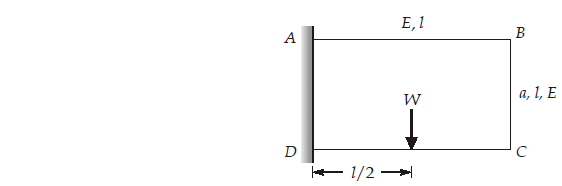
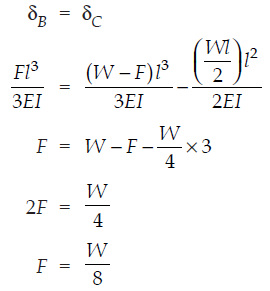
Q41. Two parallel steel cantilevers one above the other, each of length l, moment of inertia about its neutral axis I and Young’s modulus E, project horizontally from a vertical wall. Their free ends are connected together by a vertical steel tie rod of length l and cross-section area a. A load W is applied at the midpoint of the lower cantilever, the pull in the vertical steel rod is
(a) W
(b) W/2
(c) W/4
(d) W/8
Ans. d
Sol.
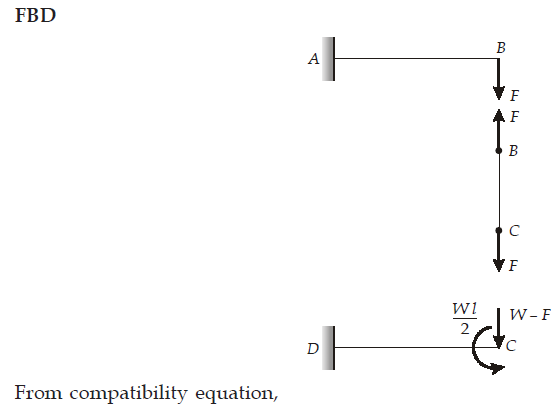
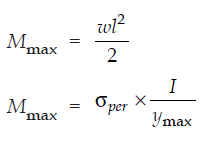
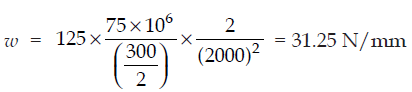
Q42. A 300 mm × 120 mm I-beam is to be used as a cantilever of 2 m long. If permissible stress is 125 MPa, then the uniformly distributed load which can be carried by the beam is [Take I = 75 × 106 mm4]
(a) 78.125 N/mm
(b) 31.25 N/mm
(c) 54.6875 N/mm
(d) 27.75 N/mm
Ans. b
Sol.
Q43. Consider the following statements regarding bending and torsional stress in structural members:
1. In pure bending; the assumption of plane sections remaining plane implies that transverse shear force is zero.
2. The ratio of maximum bending stress to maximum torsional shear stress for a beam and shaft of the same cross-section is independent of the material.
Which of the above statements is/are CORRECT?
(a) 1 only
(b) 2 only
(c) Both 1 and 2
(d) Neither 1 nor 2
Ans. c
Sol.
Stress in independent of material it only depends on the load and geometry of the cross-section.
Q44. A steel cylinder 1 m long, 0.2 m internal diameter is made of steel plates 5 mm thick. It is subjected to internal pressure of 5 MPa. The increase in volume due to internal pressure is 20 cm3. The value of poisson’s ratio is____. Assume for steel, E = 210 GPa.
(a) 0.29
(b) 0.145
(c) 0.58
(d) 0.47
Ans. c
Sol.
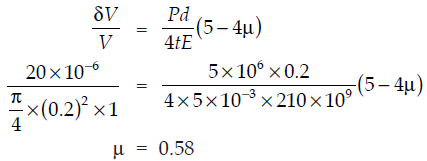
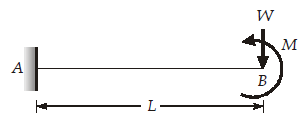
Q45. A cantilever AB of length L is subjected to a concentrated load W and a couple M acting at free end as shown in figure, then the deflection at the free end is
(a) 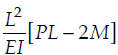
(b) 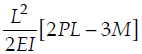
(c) 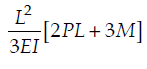
(d) 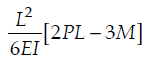
Ans. d
Sol.
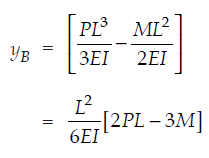
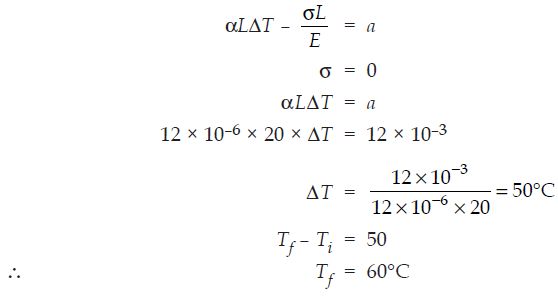
Q46. A railway is laid so that there is no stress in the rail at 10°C. The rail is 20 m long. If the expansion allowance is 12 mm per rail, then the maximum temperature to have no stress in the rails is [Take α = 12 × 10–6 per °C and E = 1 × 10⁵ N/mm2]
(a) 60°C
(b) 42°C
(c) 38°C
(d) 48°C
Ans. a
Sol.
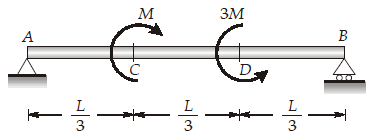
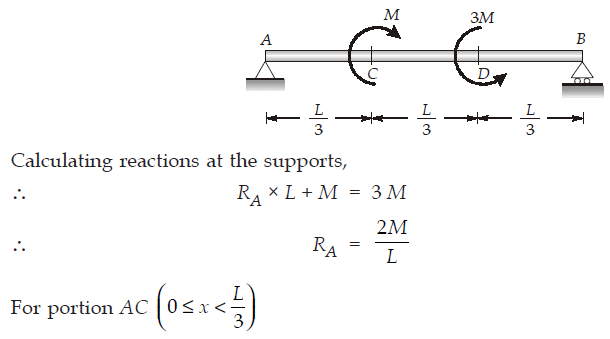
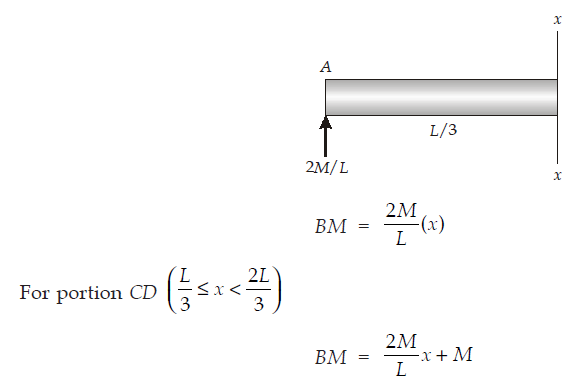
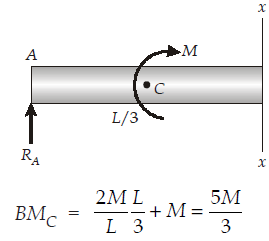
Q47. A simply supported beam AB is subjected to couples M and 3M as shown in the figure. The bending moment diagram for the beam is
(a) 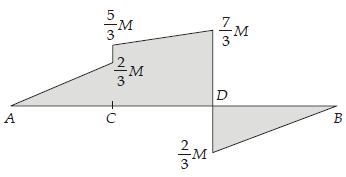
(b) 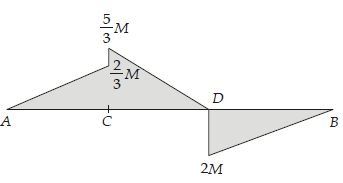
(c) 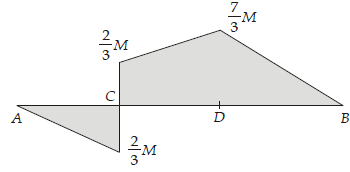
(d) 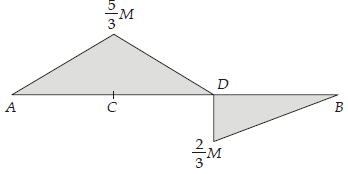
Ans. a
Sol.
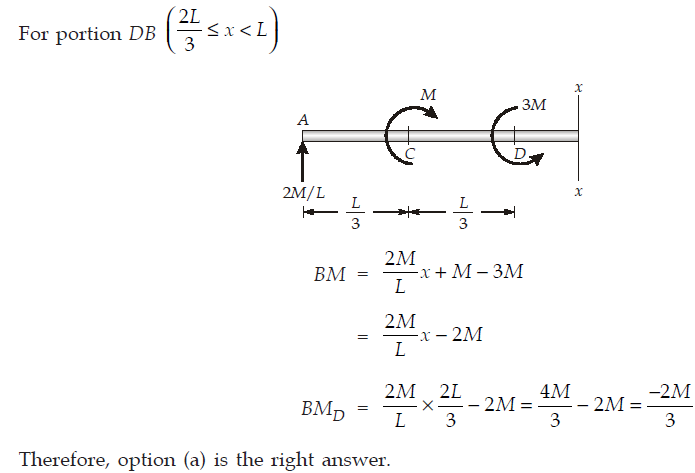
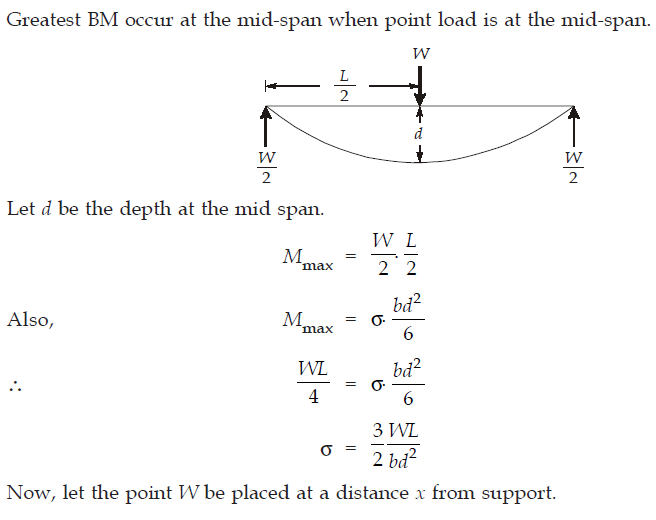
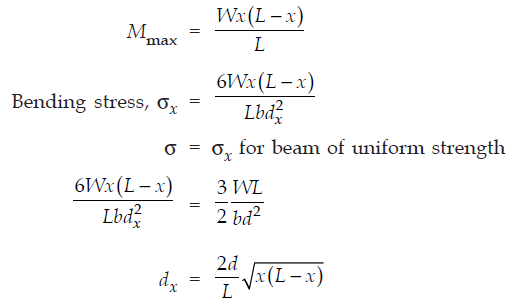
Q48. A beam of span L, simply supported at the ends, carries a point load which can be placed any where on the span, if the beam is having uniform strength, maintaining constant width throughout the length, then the expression for depth will be
(a) 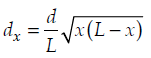
(b) 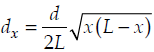
(c) 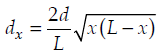
(d) 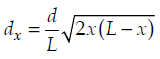
Ans. c
Sol.
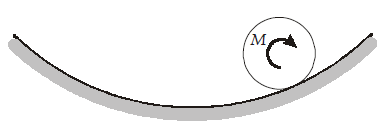
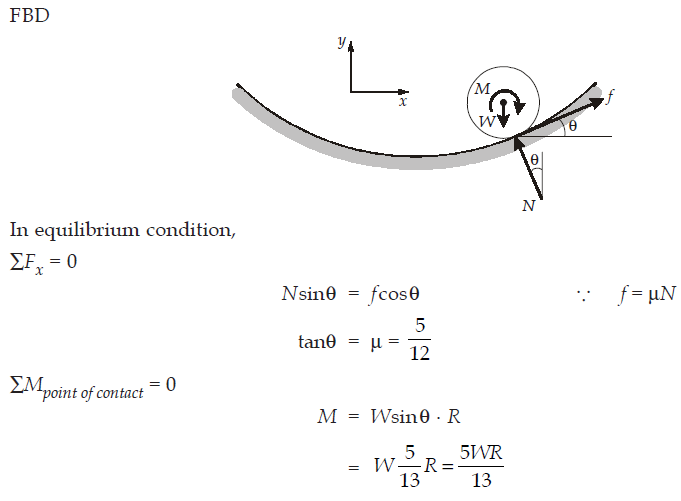
Q49. The disk of weight W and radius R is held in equilibrium on a circular surface by a couple M. If the coefficient of static friction between the disk and the surface is 5/12, then the largest value M can have without causing the disk to slip is
(a) 
(b) 
(c) 
(d) 
Ans. c
Sol.
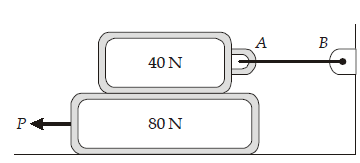
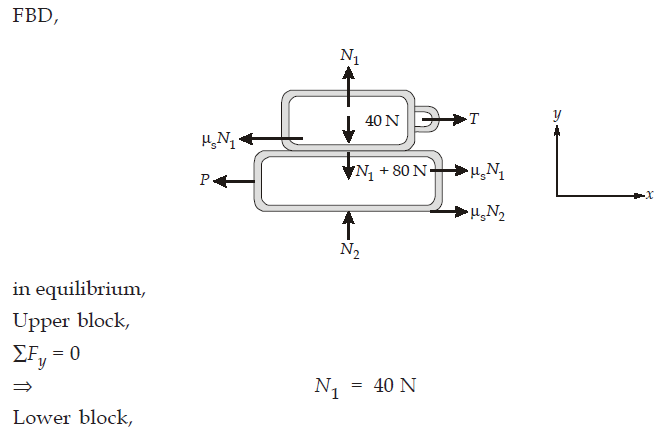
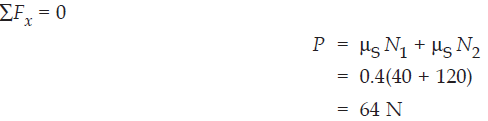
Q50. The two blocks are situated on the floor as shown in figure. The coefficients of friction are μs = 0.4 and μk = 0.3 between the all surfaces of contact. What will be the force P for which motion of the 80 N block is impending?
(a) 16 N
(b) 32 N
(c) 48 N
(d) 64 N
Ans. d
Sol.
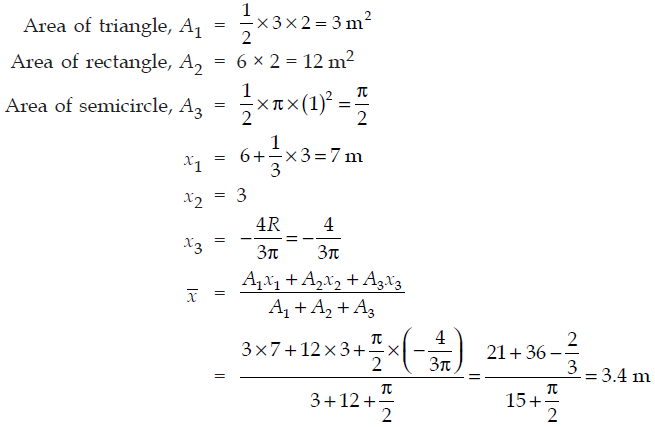
Q51. What will be the abscissa of centroid of area shown in figure with respect to the axis shown?
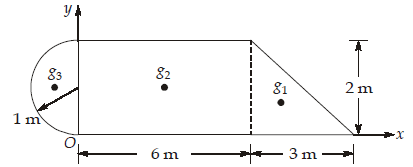
(a) 3.4 m
(b) -0.5 m
(c) 5.14 m
(d) 7.28 m
Ans. a
Sol.
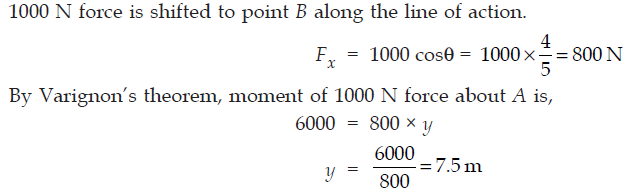
Q52. Consider the figure shown below, the y-intercept of 1000 N force if its moment about A is 6000 Nm, will be
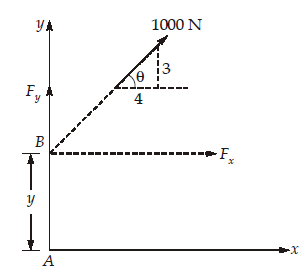
(a) 7.5 m
(b) 15 m
(c) 10 m
(d) 5 m
Ans. a
Sol.
Q53. A 10 kg block is placed on a rough horizontal surface. A horizontal force of 50 N is applied to the block. The coefficient of static and kinetic friction between the block and the surface are 0.4 and 0.3 respectively. The forward acceleration of the block will be nearly
(a) 1 m/s2
(b) 0 m/s2
(c) 2 m/s2
(d) 1.5 m/s2
Ans. c
Sol.
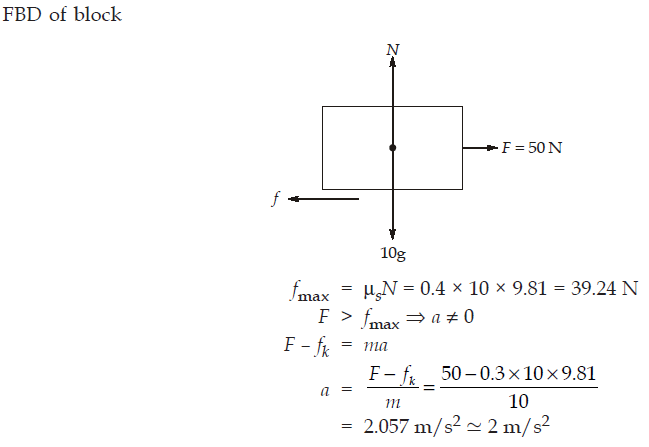
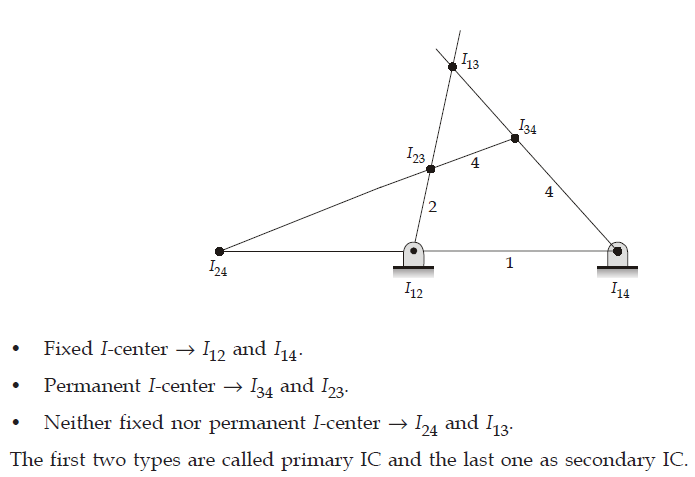
Q54. Which one of the following is also known as a secondary instantaneous center?
(a) Fixed instantaneous center
(b) Permanent instantaneous center
(c) Neither fixed nor permanent instantaneous center
(d) None of these
Ans. c
Sol.
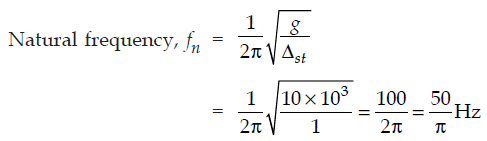
Q55. A spring undergoes a static deflection of 1 mm when a mass is suspended from it. If the acceleration due to gravity is 10 m/s2, then the natural frequency (in Hz) of the spring mass system is
(a) 
(b) 
(c) 
(d) 100
Ans. b
Sol.
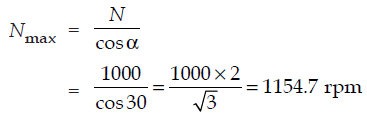
Q56. Universal joint has a shaft angle of 30°. If the driving shaft rotates at 1000 rpm, what is the maximum speed of the driven shaft?
(a) 866 rpm
(b) 1154.7 rpm
(c) 1000 rpm
(d) 1010 rpm
Ans. b
Sol.
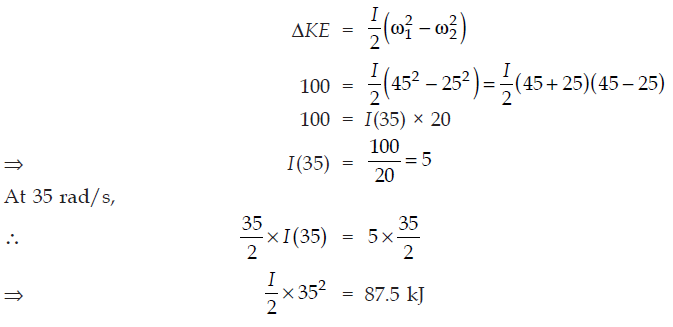
Q57. A flywheel absorbs 100 kJ of energy on increasing its speed from 25 rad/s to 45 rad/s. What will be the kinetic energy of the flywheel at 35 rad/s?
(a) 129.4 kJ
(b) 87.5 kJ
(c) 69.12 kJ
(d) 34.57 kJ
Ans. b
Sol.
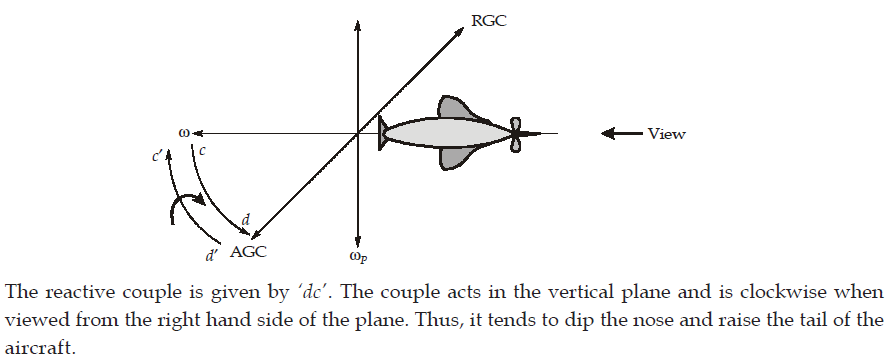
Q58. An aircraft makes a left turn while its engine rotates clockwise when viewed from the front. Which one of the following is the effect of gyroscopic couple on aircraft?
(a) Nose up
(b) Nose down
(c) Tilts towards the left
(d) Tilts towards the right
Ans. b
Sol.
Q59. Static force analysis can be valid when
(a) Inertia forces are negligible.
(b) Mass is negligible.
(c) Acceleration is high
(d) Gravitational force is absent
Ans. a
Sol.
Static force analysis is performed when the machine is either at rest or moving at very low acceleration meaning inertia forces can be ignored. This simplifies force calculations, making the analysis static instead of dynamic.
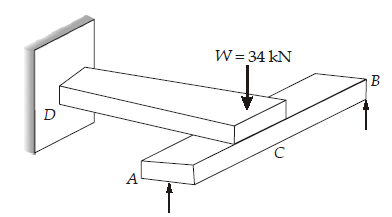
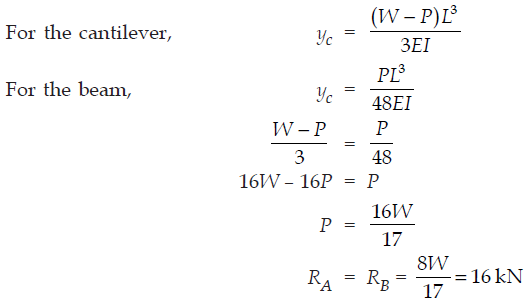
Q60. A beam AB of span 5 m is simply supported at A and B as shown in figure below. A cantilever DC of length 5 m, which is fixed at D, nuts the beam AB at the mid-point C, thereby forming a rigid joint at C. If a vertical load W = 34 kN is applied at the end C of the cantilever, then the reaction at A will be
(a) 8 kN
(b) 18 kN
(c) 17 kN
(d) 16 kN
Ans. d
Sol.
Q61. 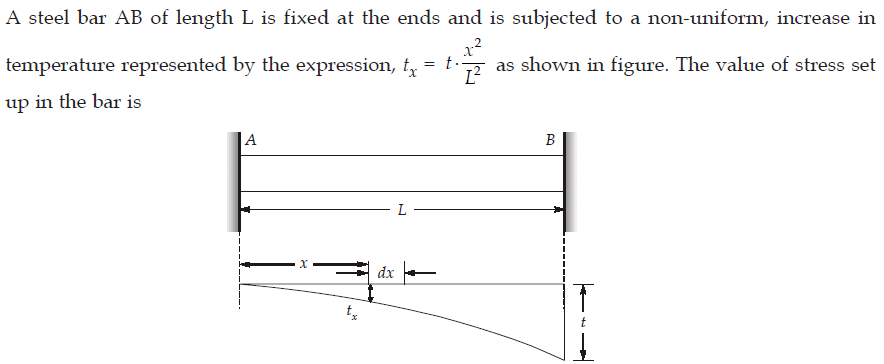
(a) 
(b) 
(c) 
(d) 
Ans. a
Sol.
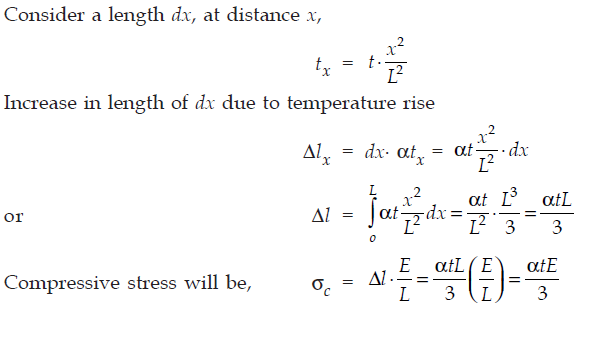
Q62. A block of 200 N is kept on the block of 1000 N by a string on a inclined surface as shown in figure, the coefficient of friction for all contact surfaces is 0.5, the value of angle ‘θ’ for equilibrium will be
(a) 
(b) 
(c) 
(d) 
Ans. d
Sol.
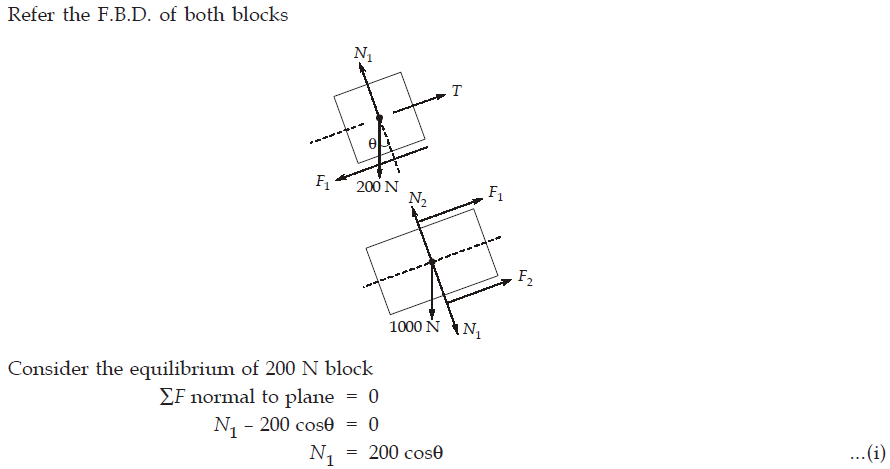
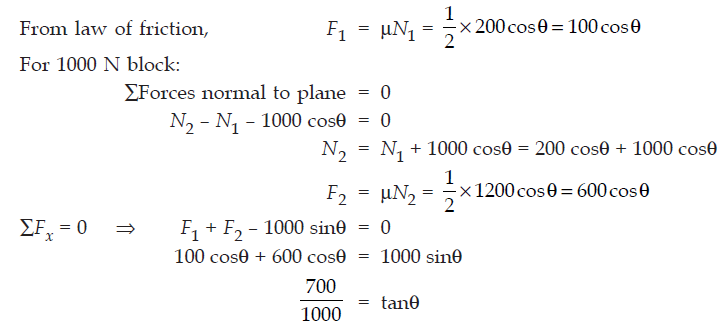

Q63. A small project consists of seven activities for which the relevant data are given below:
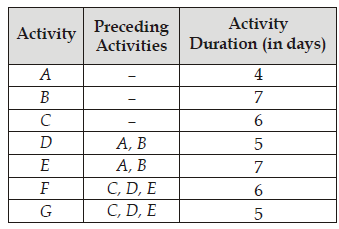
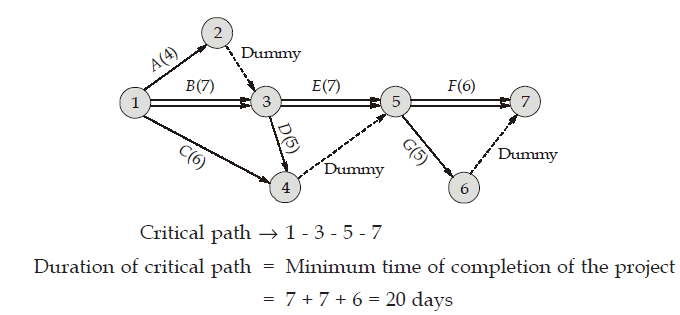
The minimum time of completion of the project is
(a) 24 days
(b) 20 days
(c) 12 days
(d) 17 days
Ans. b
Sol.
Q64. Which of the following NDT method is used to detect crack of flow by measuring the variation in coil impedance?
(a) Radiography x-ray
(b) Radiography γ-ray
(c) Ultrasonic inspection
(d) Eddy current inspection
Ans. d
Sol.
Eddy current testing is one of the methods of detecting discontinuities and flaws. The method is based on the principle that when the alternate current carrying conductor coil is brought near a metallic conductive specimen, eddy currents are induced in the specimen due to electromagnetism. These eddy currents produce their own magnetic field that opposes the field of the current carrying coil, thereby increasing the impedance (resistance). Coil impedance can be measured whose variation indicates the crack or flaw.
Q65. A company is selling a product for Rs10 per unit with variable cost of Rs 5 per unit. The fixed cost of the asset is Rs 40000. How many units should be produced for breakeven?
(a) 4000
(b) 5000
(c) 8000
(d) 10000
Ans. c
Sol.
Revenue = Fixed cost + Variable cost + Profit
For breakeven profit = 0
Revenue = FC + VC
Let the breakeven be x
x· [10] = 40000 + x(5)
5x = 40000
x = 8000 units
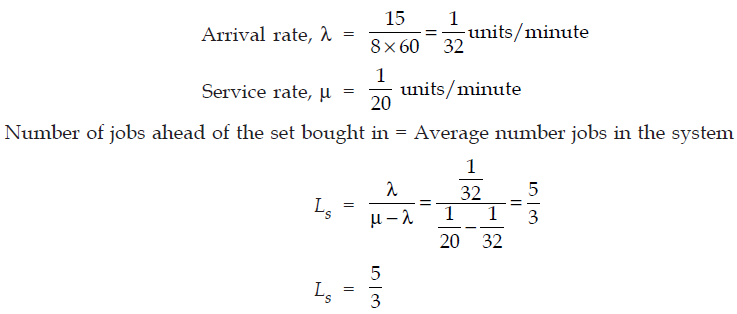
Q66. A radio repairing station with Poisson arrival rate of 15 for 8 hours day and repairing services are exponentially distributed with a mean service time of 20 minutes. How many jobs are ahead of the average set just bought in?
(a) 2/3
(b) 3/2
(c) 5/3
(d) 5/2
Ans. c
Sol.
Q67. For an n-DOF manipulator, the number of independent joint link variables are required to completely specifying the location of the end effector in space is
(a) (n – 1)
(b) n
(c) (n + 1)
(d) (n + 2)
Ans. b
Sol.
Because each joint has only one degree of freedom.
Q68. For a robotic manipulator, the space where the end effector can reach every point from all orientations is known as
(a) Reachable workspace
(b) Dexterous workspace
(c) Joint space
(d) Cartesian space
Ans. b
Sol.
• Reachable workspace : The region that can be reached by the origin of the end effector frame with at least one orientation is called reachable workspace.
• Joint space : The set of all (n × 1) joint displacement vectors generates the joint vector space or joint space.
• Cartesian space : The configuration of the end effector is represented by three position components as displacements along three orthogonal axes of base frame and three rotations about the base frame axes. These six components can be represented by a six dimensional space called configuration space or cartesian space.
Q69. Which of the following rivet heads is used for light sheet metal work?
(a) Snap head rivet
(b) Flat head rivet
(c) Counter sunk head rivet
(d) Pan head rivet
Ans. b
Sol.
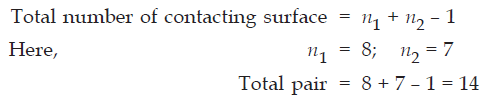
Q70. If their are 8 discs on the driving shaft and 7 discs on the driven shaft in a multiplate clutch, then the number of pairs of contact surfaces will be equal to
(a) 18
(b) 17
(c) 35
(d) 14
Ans. d
Sol.
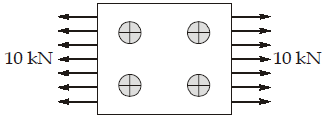
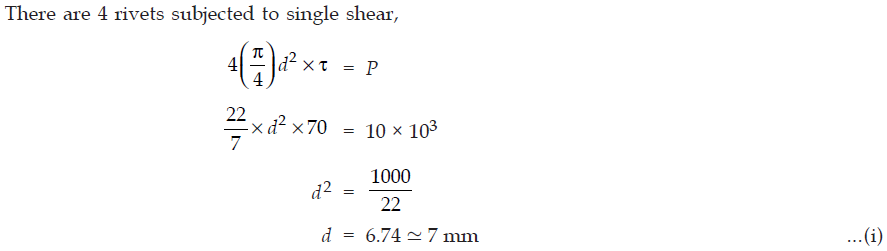
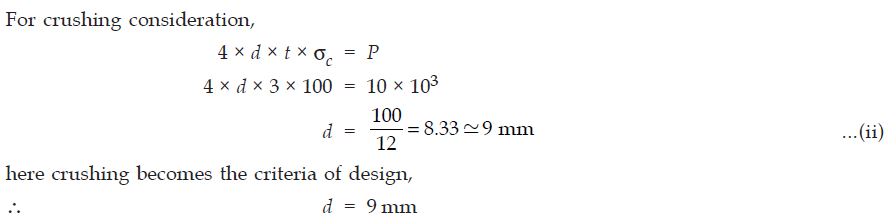
Q71. Two plates are hinged together by 4 rivets as shown. If the permissible stress for the rivet in shear and compression are 70 and 100 N/mm2 respectively, then the size of the rivets needed for the load of 10 kN is
[Take thickness of plate as 3 mm]
(a) 7 mm
(b) 10 mm
(c) 9 mm
(d) 12 mm
Ans. c
Sol.
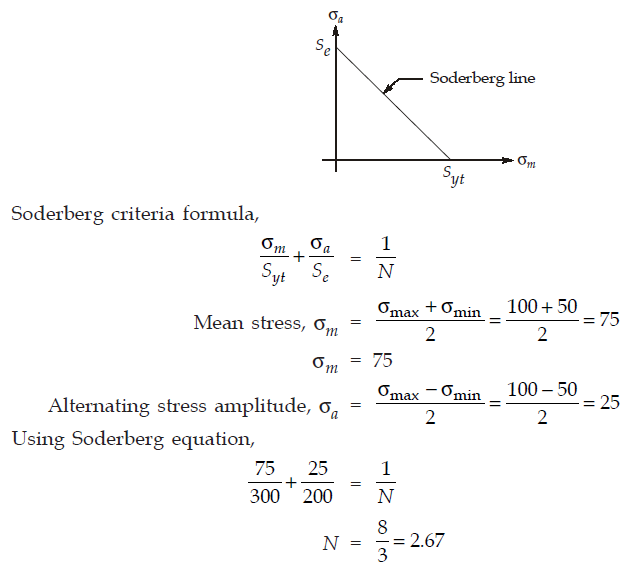
Q72. A steel connecting rod having Syt = 300 MPa and Se = 200 MPa is subjected to fluctuating stresses, with a maximum stress of 100 MPa and a minimum stress of 50 MPa. According to the soderberg criteria, what is the factor of safety (FOS)?
(a) 2.67
(b) 3.57
(c) 4.57
(d) 1.67
Ans. a
Sol.
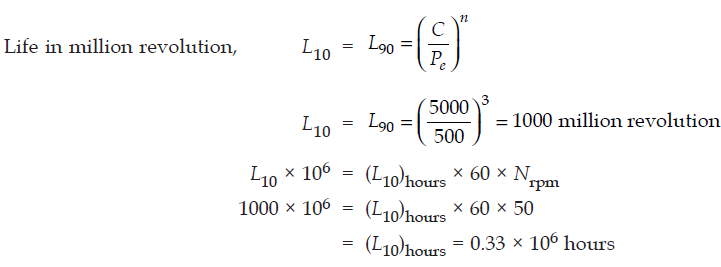
Q73. What is the expected life in hours for a ball bearing with load rating of 5000 kg, carrying a radial load of 500 kg and rotating at 50 rpm?
(a) 1.33 × 10⁶ hours
(b) 2.33 × 10⁶ hours
(c) 0.33 × 10⁶ hours
(d) 106 hours
Ans. c
Sol.
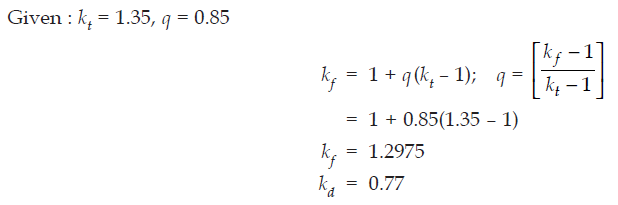
Q74. A cantilever beam made of cold drawn steel 20C8. The notch sensitivity factor q at the fillet is 0.85 and theoretical stress concentration factor is 1.35., then the value of fatigue stress concentration factor is
(a) 0.77
(b) 0.29
(c) 0.42
(d) 0.63
Ans. a
Sol.
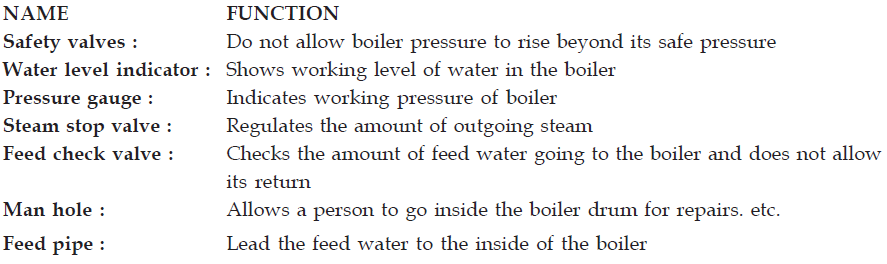
Q75. Match List-I (Boiler Mountings) with List-II (Functions) and select the correct answer using the codes given below the lists:
List-I
A. Steam stop valve
B. Feed pipe
C. Feed check valve
D.Safety valves
List-II
1. Lead the feed water to the inside of the boiler.
2. Checks the amount of feed water going to the boiler and does not allow it returns.
3. Regulates the amount of outgoing steam.
4. Don’t allow boiler pressure to rise beyond its safe pressure.
Codes:
A B C D
(a) 3 1 4 2
(b) 1 3 4 2
(c) 3 1 2 4
(d) 1 3 2 4
(a) (a)
(b) (b)
(c) (c)
(d) (d)
Ans. c
Sol.
Q76. A stream of air is passed through a cooling tower, the process involved is
(a) Adiabatic saturation
(b) Cooling and dehumidification
(c) Heating and humidification
(d) Evaporative cooling
Ans. d
Sol.
Cooling tower is a heat rejection device which is used to cool the water stream by evaporating some of the water flow into an air stream.
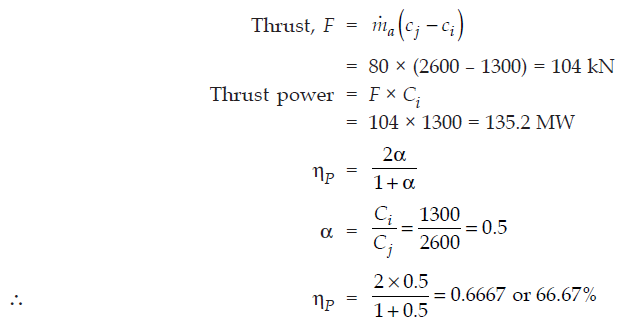
Q77. The effective jet exit velocity from a jet engine is 2600 m/s. The forward flight velocity is 1300 m/s and the air flow rate is 80 kg/s. The thrust power and propulsive efficiency are
(a) 104.1 MW, 56.67%
(b) 104.1 MW, 66.67%
(c) 135.2 MW, 56.67%
(d) 135.2 MW, 66.67%
Ans. d
Sol.
Q78. Consider the following characteristics of the Ram Jet engine:
1. It is a simple engine and should be adaptable for mass production at relatively low cost.
2. It is independent of fuel technology and a wide range of liquid and even solid fuels can be used.
3. Its fuel consumption is comparatively very less for its application in aircraft propulsion or in missiles at low and moderate speed.
Which of the above statements are CORRECT?
(a) 1 and 2 only
(b) 2 and 3 only
(c) 1 and 3 only
(d) 1, 2 and 3
Ans. a
Sol.
The basic characteristics of the ramjet engine can be summarized as follows:
(i) It is a simple engine and should be adaptable for mass production at relatively low cost.
(ii) It is independent of fuel technology and a wide range of liquid, and even solid fuels can be used.
(iii) Its fuel consumption is comparatively very large for its application in aircraft propulsion or in missiles at low and moderate speeds.
(iv) Its fuel consumption decreases with flight speed and approaches reasonable values when the flight Mach number is between 2 and 5 and therefore, it is suitable for propelling supersonic missiles.
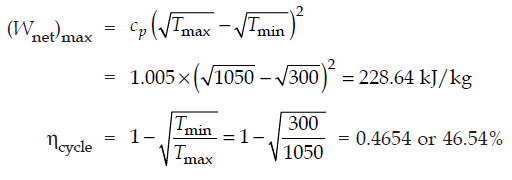
Q79. In an Ideal Brayton cycle, air from the atmosphere at 1 atm, 300 K is compressed to 6 atm and the maximum cycle temperature is limited to 1050 K by using a large air fuel ratio. The maximum work done per kg of air and the corresponding cycle efficiency are
(a) 228.64 kJ/kg, 56.54%
(b) 328.64 kJ/kg, 46.54%
(c) 228.64 kJ/kg, 46.54%
(d) 328.64 kJ/kg, 56.54%
Ans. c
Sol.
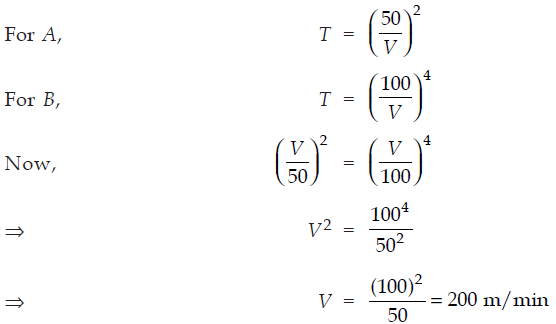
Q80. A MS workpiece is being machined by two different tools ‘A’ and ‘B’ under identical machining conditions. The tool life equations for these tools are:
For tool A : VT0.5 = 50
For tool B : VT0.25 = 100
The cutting speed above which tool A will give better tool life than tool B is
(a) 100 m/min
(b) 150 m/min
(c) 200 m/min
(d) 50 m/min
Ans. c
Sol.
Q81. P, Q, R, S, T, U and V are sitting around a circular table facing the centre (not necessarily in the same order). P is sitting to the immediate left of V. R is sitting to the immediate right of T. U is sitting to the immediate left of P and immediate right of S. Q is sitting to the immediate left of S. T is sitting to the immediate right of V. Who is sitting to the immediate left of Q?
(a) P
(b) R
(c) V
(d) U
Ans. b
Sol.
As per the given information, arrangement is shown below:
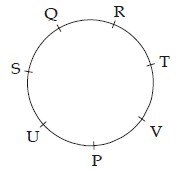
So, R is immediate left of Q.
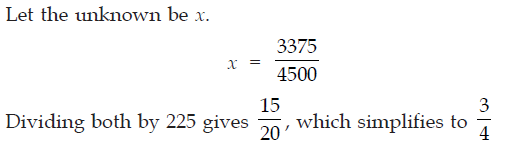
Q82. 4500 × ? = 3375
(a) 2/5
(b) 3/4
(c) 1/4
(d) 3/5
Ans. b
Sol.
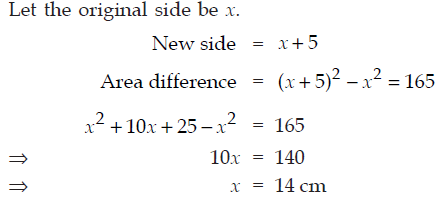
Q83. If the side of a square is increased by 5 cm, the area increases by 165 sq.cm. The side of the original square is
(a) 12 cm
(b) 13 cm
(c) 14 cm
(d) 15 cm
Ans. c
Sol.
Q84. ABCDEF is a regular hexagon of side 2 feet. The area, in square feet, of the rectangle BCEF is:
(a) 8
(b) 
(c) 4
(d) 
Ans. d
Sol.

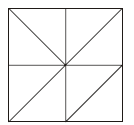
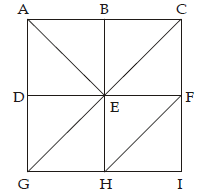
Q85. How many triangles are there in the given figure?
(a) 11
(b) 14
(c) 12
(d) 13
Ans. c
Sol.
Triangles in the figure are
ΔABE, ΔADE, ΔDEG, ΔEGH, ΔEFH, ΔFHI, ΔBCE, ΔECF, ΔACE, ΔAEG, ΔACG, ΔGCI
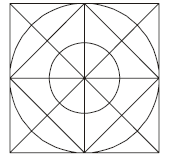
Q86. Select the option figure that will replace the question mark (?) in the figure given below to complete the pattern.
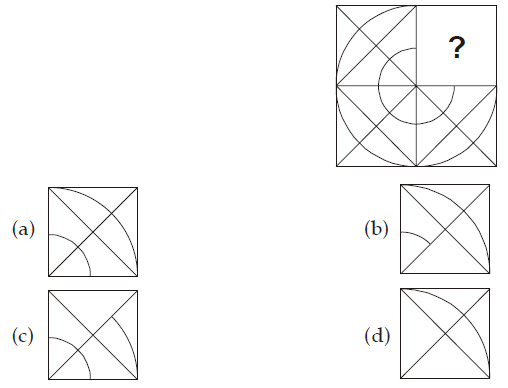
(a) (a)
(b) (b)
(c) (c)
(d) (d)
Ans. a
Sol.
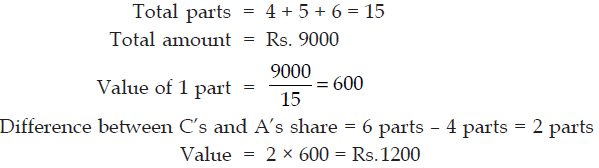
Q87. A sum of Rs. 9,000/- is to be distributed among A, B and C in the ratio of 4 : 5 : 6. What will be the difference between A’s and C’s shares?
(a) Rs. 600/-
(b) Rs. 1,000/-
(c) Rs. 900/-
(d) Rs. 1,200/-
Ans. d
Sol.
Q88. A is B’s sister. C is B’s mother. D is C’s father. E is D’s mother. Then, how is A related to D ?
(a) Grandfather
(b) Grandmother
(c) Daughter
(d) Granddaughter
Ans. d
Sol.
Break down the relationships step-by-step:
C is A’s mother.
D is C’s father.
Since D is the father of A’s mother, D is A’s maternal grandfather.
Because the question asks for A’s relationship to D (and A is implicitly female in these specific puzzles based on the options), A is the granddaughter of D.
Q89. “A” and “B” can do a piece of work in 8 days which “A” alone can do in 12 days. In how many days “B” alone do the same work?
(a) 24 days
(b) 16 days
(c) 20 days
(d) 18 days
Ans. a
Sol.

Q90. If ZEBRA can be written as 2652181. How can COBRA be written?
(a) 302181
(b) 3152181
(c) 31822151
(d) 1182153
Ans. b
Sol.
Write the place value of each alphabet: C = 3, O = 15, B = 2, R = 18, A = 1
Q91. 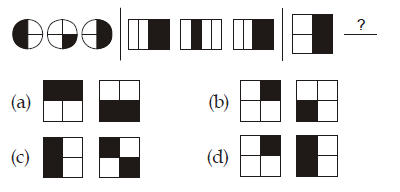
(a) (a)
(b) (b)
(c) (c)
(d) (d)
Ans. d
Sol.
(d)
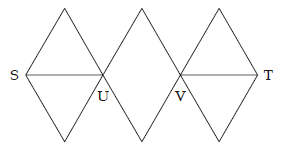
Q92. With reference to the figure given below, the number of different routes from S to T without retracing from U and/or V, is
(a) 3
(b) 6
(c) 9
(d) 18
Ans. d
Sol.
This is a basic permutations/combinations problem based on the multiplication principle.
If there are 3 distinct paths from S to U, 2 distinct paths from U to V, and 3 distinct paths from V to T, the total number of unique continuous routes from S to T is the product of the individual leg choices:
3 × 2 × 3 = 18 paths
Q93. Three views of the cube are given below:
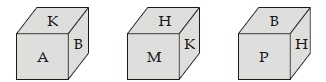
What is letter opposite to A?
(a) H
(b) P
(c) B
(d) M
Ans. c
Sol.
In standard non-verbal reasoning problems involving flattened or multi-view cubes, you observe the adjacent faces. If letters C, D, E, and F are shown to be adjacent to A in the various projections, the only remaining face that cannot be adjacent, and must therefore be opposite to A, is B.
Q94. In a class of 45 students, a boy is ranked 20th When two boys joined, his rank was dropped by one. What is his new rank from the end?
(a) 25th
(b) 26th
(c) 27th
(d) 28th
Ans. c
Sol.
Initially, the class size is 45. When two new students join, the total becomes 45 + 2 = 47.
The student’s original rank was dropped by one position due to the new joining, making his new rank from the top 21st.
To find his rank from the bottom, use the formula:
Rank from bottom = Total students – Rank from top + 1.
Rank = 47 – 21 + 1 = 27th
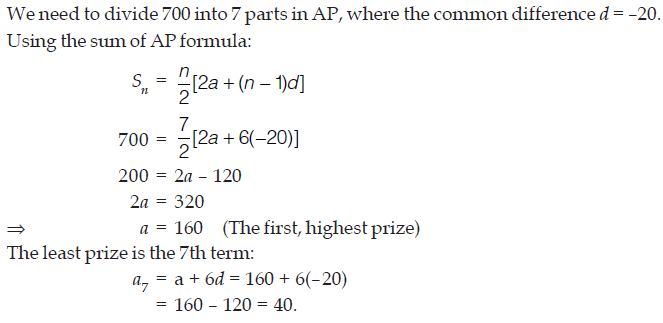
Q95. A sum of Rs.700 has to be used to give seven cash prizes to the students of a school for their overall academic performance. If each prize is Rs.20 less than its preceding prize, then what is the least value of the prize?
(a) Rs.30
(b) Rs.40
(c) Rs.60
(d) Rs.80
Ans. b
Sol.